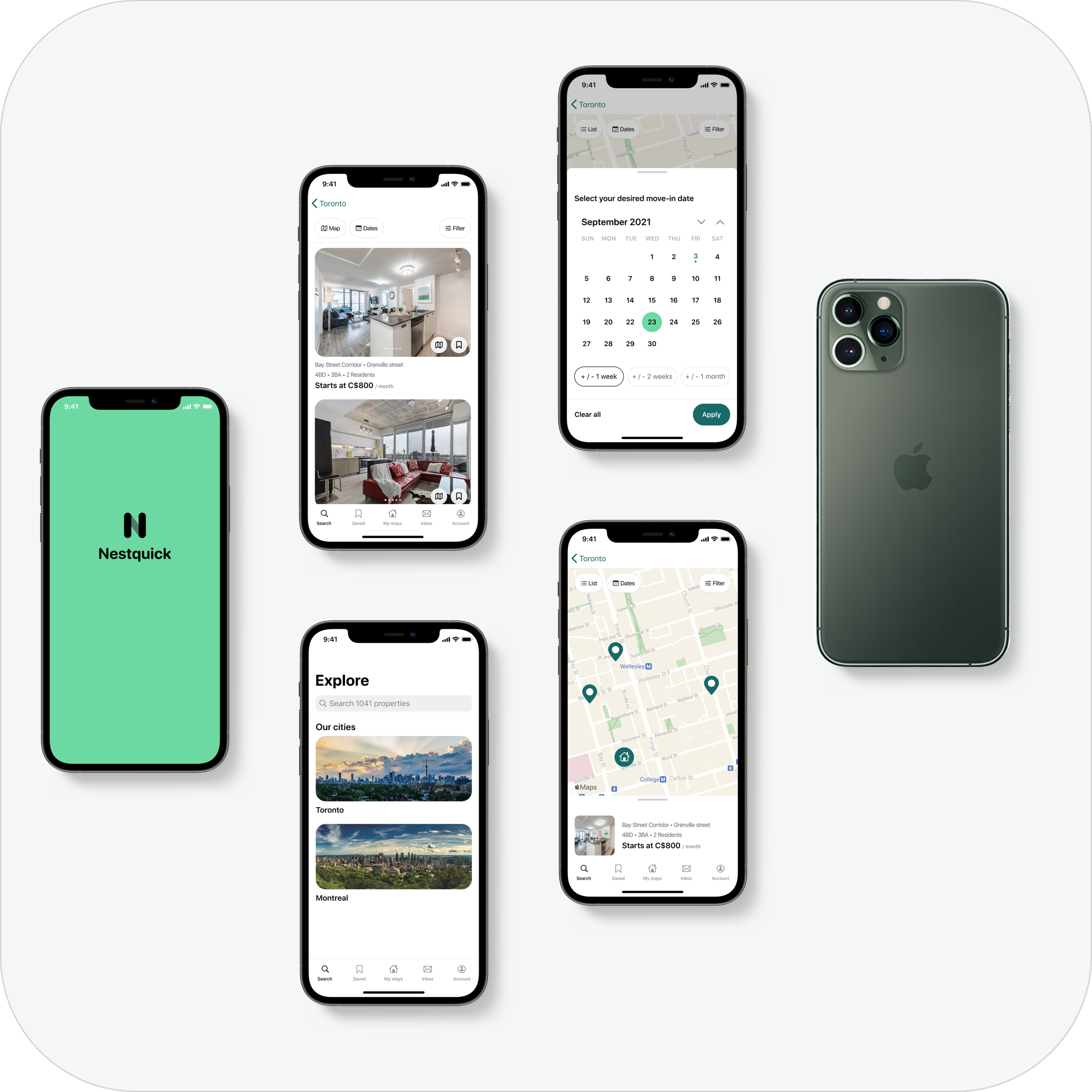
Nestquick: co-living app
Overview
The scope: Create an app for a co-living company (currently operates in Toronto and Montreal with potential for future expansion), involving renting private bedrooms in multi-bedroom rental properties and finding the best prospect roommate match.
Role: Product Designer (end-to-end UX/UI, research, visual design)
Platform: iOS
Type: Academic project · Proptech/ Hospitality
Timeline: 8 weeks
The context
With fast-rising housing prices, far-reaching effects of student debts, and a consistent trend toward later marriages, many young adults turn to living with roommates. People live with strangers to save money and maintain a higher standard of living than they might be able to afford on their own.
It’s clear that along with benefits, having roommates may cause a lot of frustration. But is there a product that could help keep the good parts of the sharing experience and eliminate as many flaws as possible? Can design and technology solve challenges and decrease pains people with roommates encounter?
I. Research
Preliminary research
According to a new Square One Insurance survey, approximately 30% of Canadians rent their homes, and many share their home with a roommate (the share fluctuates between 15% and 30%).
From 2018 to 2019, across British Columbia, Alberta and Ontario, the share of renters who have roommates experienced an increase ranging from 5% to 10%. Toronto had the highest percentage of roommates out of every major city in Canada, at around 33%.
As of 2020, 53% of renters say they choose a roommate to help with rent, while 27% of respondents tend to live with roommates for companionship.
The SpareRoom Community conducted a study to better understand what matters to people when looking for a roommate. After surveying over 6,000 roommates and roommate-seekers, some additional statistics were found.
Key study findings
⇢ 99% of respondents want a roommate who is respectful, reliable and clean
⇢ Most listed “quiet” and “friendly” as a key factors
⇢ While 74% of participants said they didn't want to share space with a smoker, 34% would prefer it if their roommate smoked
⇢ 65% of females and 42% of males factor in gender to their search
⇢ 33% of respondents said they want roommates to share their interests
Qualitative research
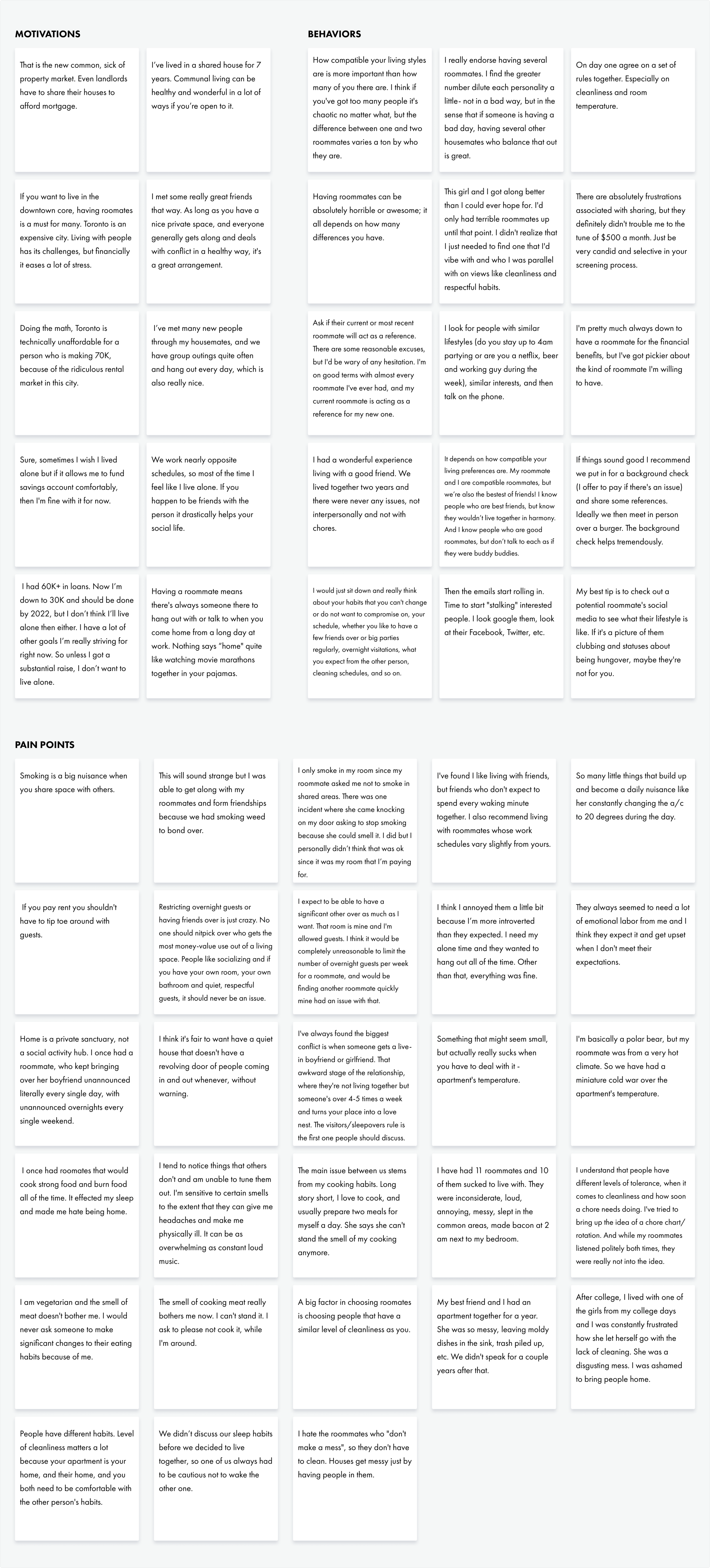
While preliminary research data helped me get an idea of some aspects of the topic, I wanted to gain a more comprehensive view and learn what was going on in shared households from real people. I wrote an interview script and interviewed 5 people from Toronto and Montreal, who I knew had many years of experience of renting with roommates. Listening to renters talk about their reasons to live with roommates, the screening process, the best and worst roommate experiences, the biggest frustrations and sources of conflict helped me understand their needs and goals and further refine the problem statement. Additionally, I inquired about existing solutions they were using to look for roommates and rental properties and their experiences with those solutions.
I then sorted through responses to derive people’s motivations, behaviors, top sources of pain and identify common themes and factors to focus on.
Interview key insights 💬
By analyzing the data received through interviews, I discovered:
➣ 1. Best friends don’t always make best roommates. Sharing experience based on a prior friendship puts friendship at risk of getting strained. 3 out 5 respondents deliberately avoided living with friends due to negative experience in the past.
➣ 2. Roommate screening process can be daunting and time consuming.
➣ 3. Most frequent matters to become points of contention in an otherwise positive sharing experience are sleep schedules, levels of cleanliness and noise, visitation policy, smoking, cooking habits, diet preferences, and, surprisingly enough, air conditioner settings (room temperature), which was mentioned quite a few times.
➣ 4. Social expectations of roommates vary. Some people are attracted to the idea of becoming best friends with roommates, whereas others insist that being cordial is sufficient enough, “friendly but not friends”. However, the majority agrees (4 out of 5), it’s important to factor in living preferences/ standards and have expectations aligned. Even if a roommate doesn’t become the closest friend, it still can be a smooth sharing experience.
➣ 5. Due to budgetary restrictions, the majority of respondents had to choose between living with roommates downtown and living alone in suburbs/outskirts of the city. They would rather live with roommates to keep rent low than brave a long commute, which is both time consuming and mentally draining.
➣ 6. Some respondents mentioned they opted for shared accommodation as they would rather live with roommates and have access to a large number of building amenities than live alone at a place without any amenities for the same budget.
II. Jobs to be done
Additionally, I employed the JTBD concept to better my empathy with prospective users, and identify customer jobs to be done and their motivations to “hire” a product.
➣ 1. The number of people living in shared households experience growth as rental prices continue to rise. Co-living attempts to solve problems around quality of life, affordability and commute time.
➣ 2. Co-living helps reduce time and avoid stress related to screening/ interviewing potential roommates and conducting their background checks before a good match is eventually found. It can also help evoke a feeling of trust and security by protecting users from becoming a victim of the roommate scam.
➣ 3. By offering individual room leases, co-living eliminates financial liability of roommates and the stress around the need to urgently look for a replacement if a roommate decides to move out.
➣ 4. Co-living provides customers with flexible lease options. It can be extremely useful for those who are new in the city and want to get a feel of a neighborhood before settling down or simply don’t plan on staying for the long term.
➣ 5. Negotiating chores with roommates can be challenging for a variety of reasons. Co-living tackles this problem by including professional cleaning services in monthly rent.
➣ 6. Co-living comes with a built-in community and can help connect people who are on the same level.
➣ 7. Co-living offers residents a sufficient way to live and travel light by having all utilities, furniture, supplies, kitchen wire/ utensils and internet included in one monthly payment.
III. User personas
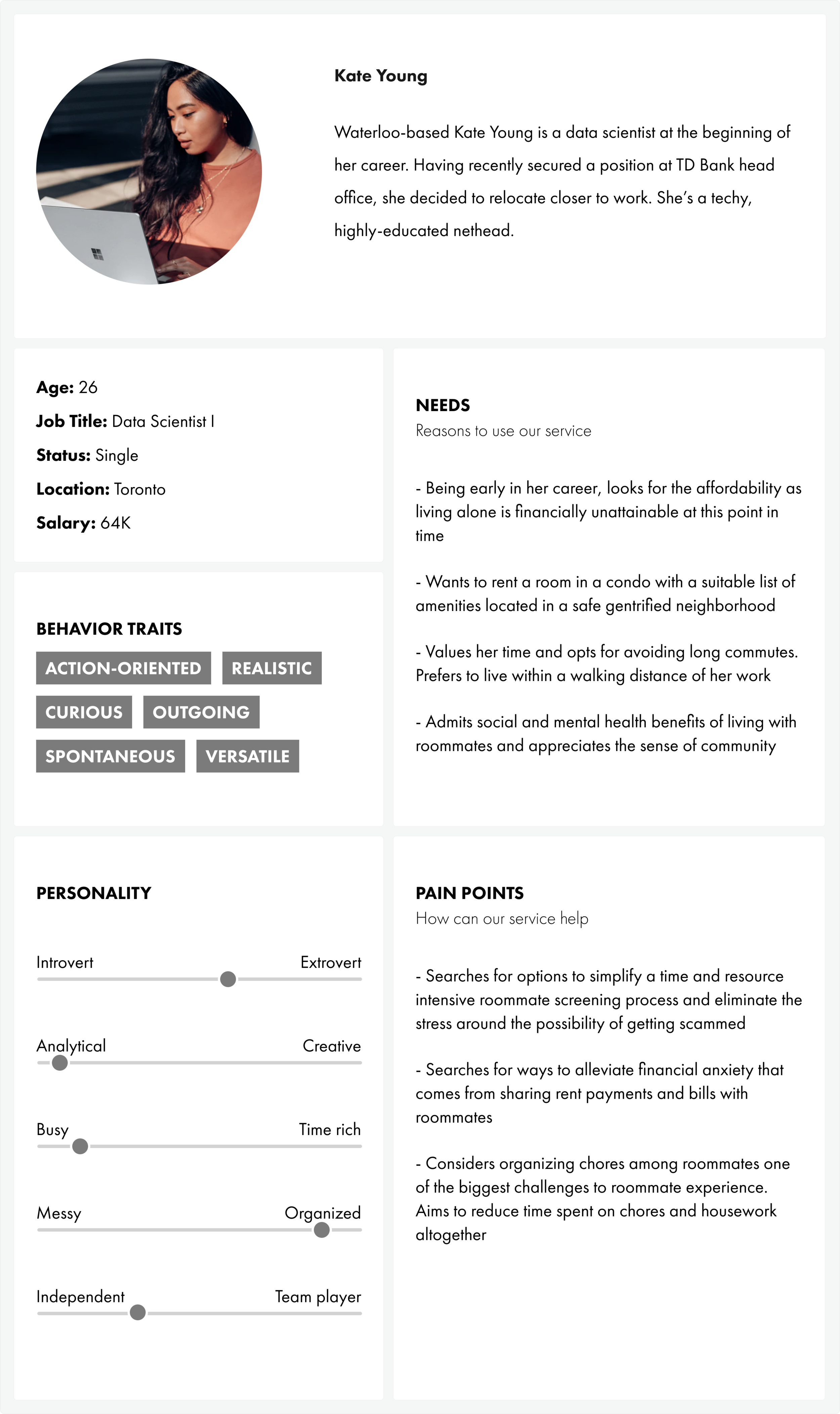
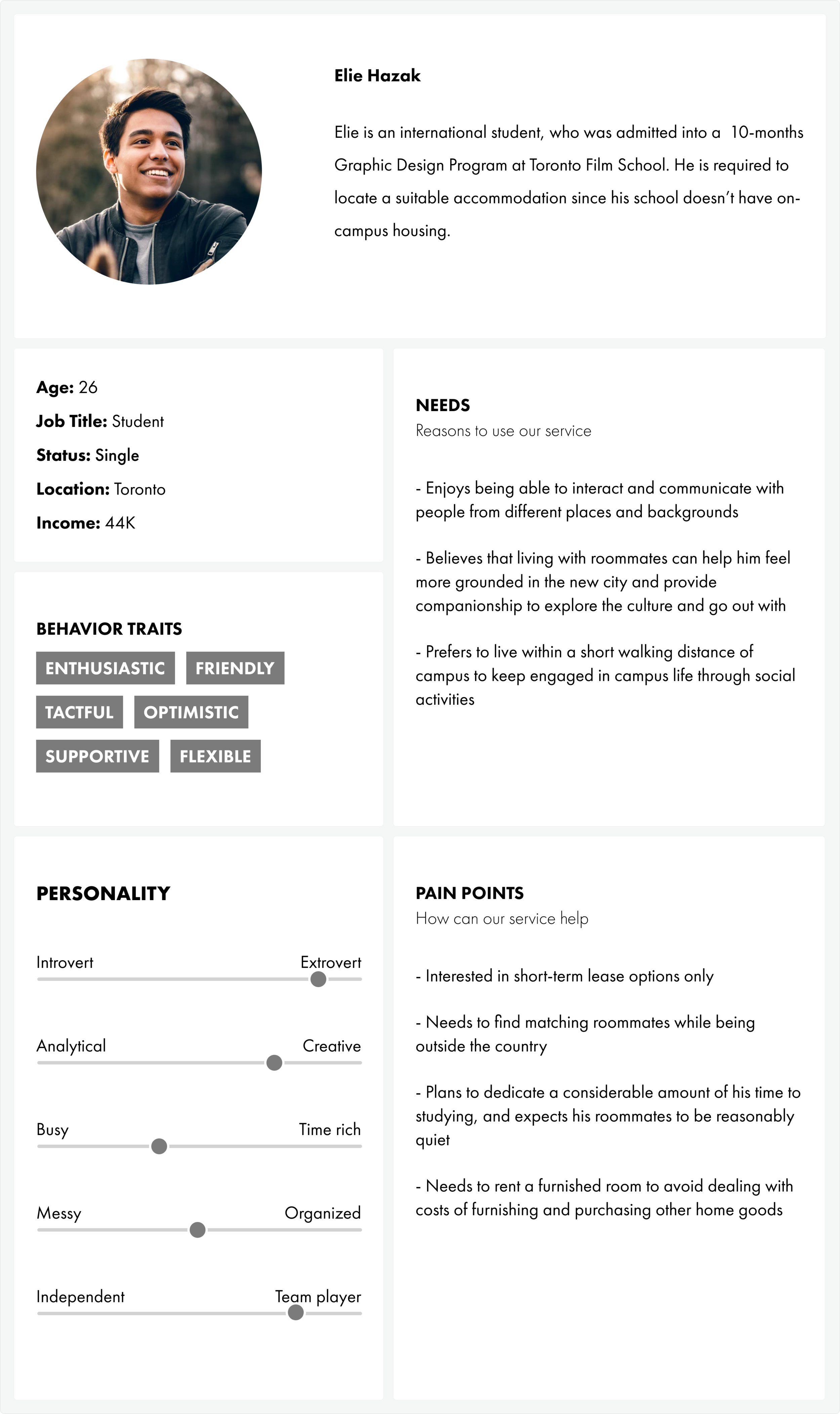
Having synthesized data received from research and JTBD, I crafted two representative user personas, enhanced by personal and behavioral details, user needs and pain points to help me in forthcoming decision making.
Primary user persona
Secondary user persona
IV. Customer journey map
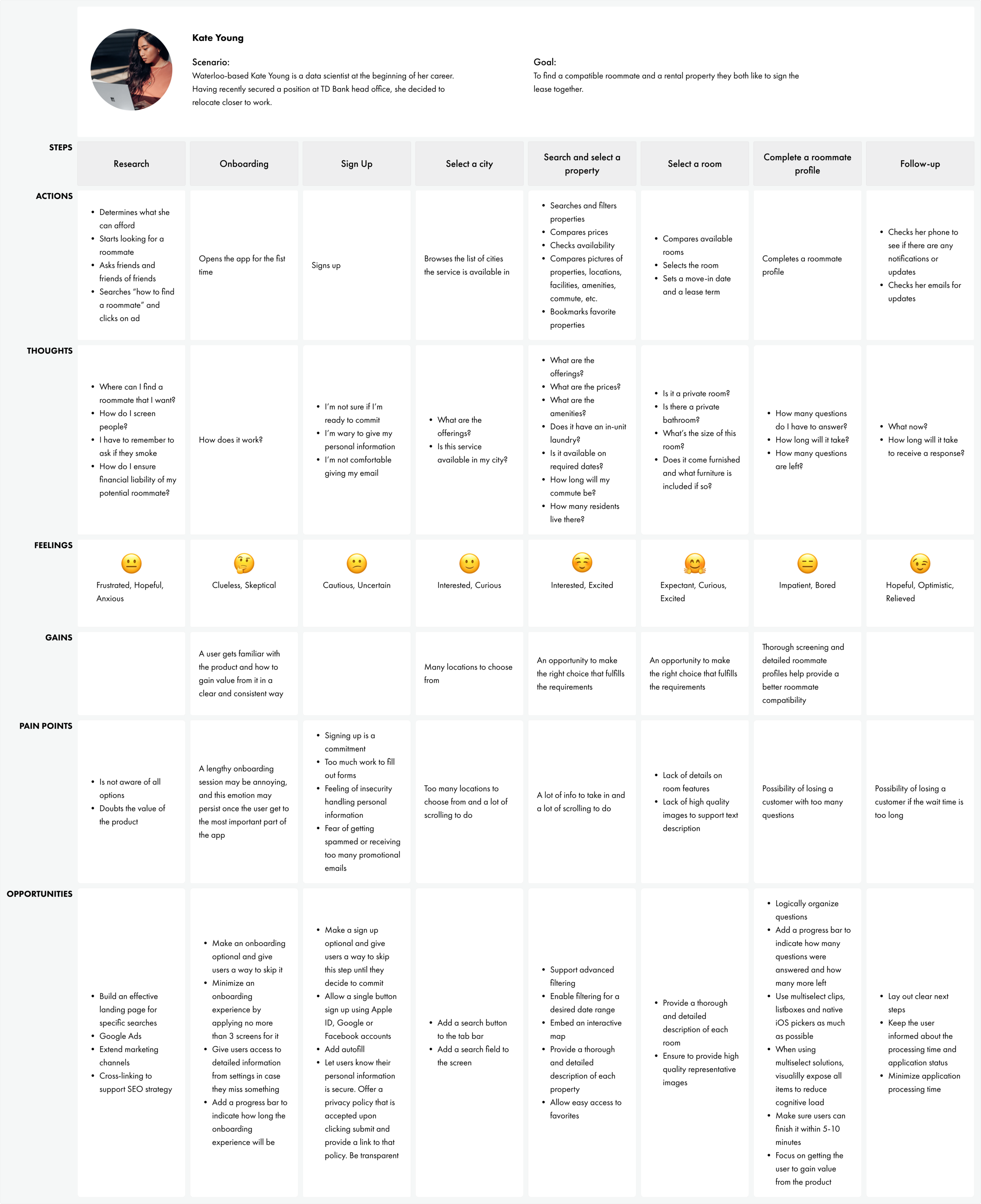
In an attempt to improve my understanding of the user and grasp an entire customer experience in both holistic and concise way, a CJM was created. It reveals moments of user’s contentment and dissatisfaction, and uncovers opportunities to address pain points. Along with user personas, it’s to become the basis for decision making as I move forward.
V. Task flow & wireframes
Reviewing my personas and user journeys and having certain features in mind, I started to think about the structure of the app: what types of actions my users would like to take and why they would take these actions.
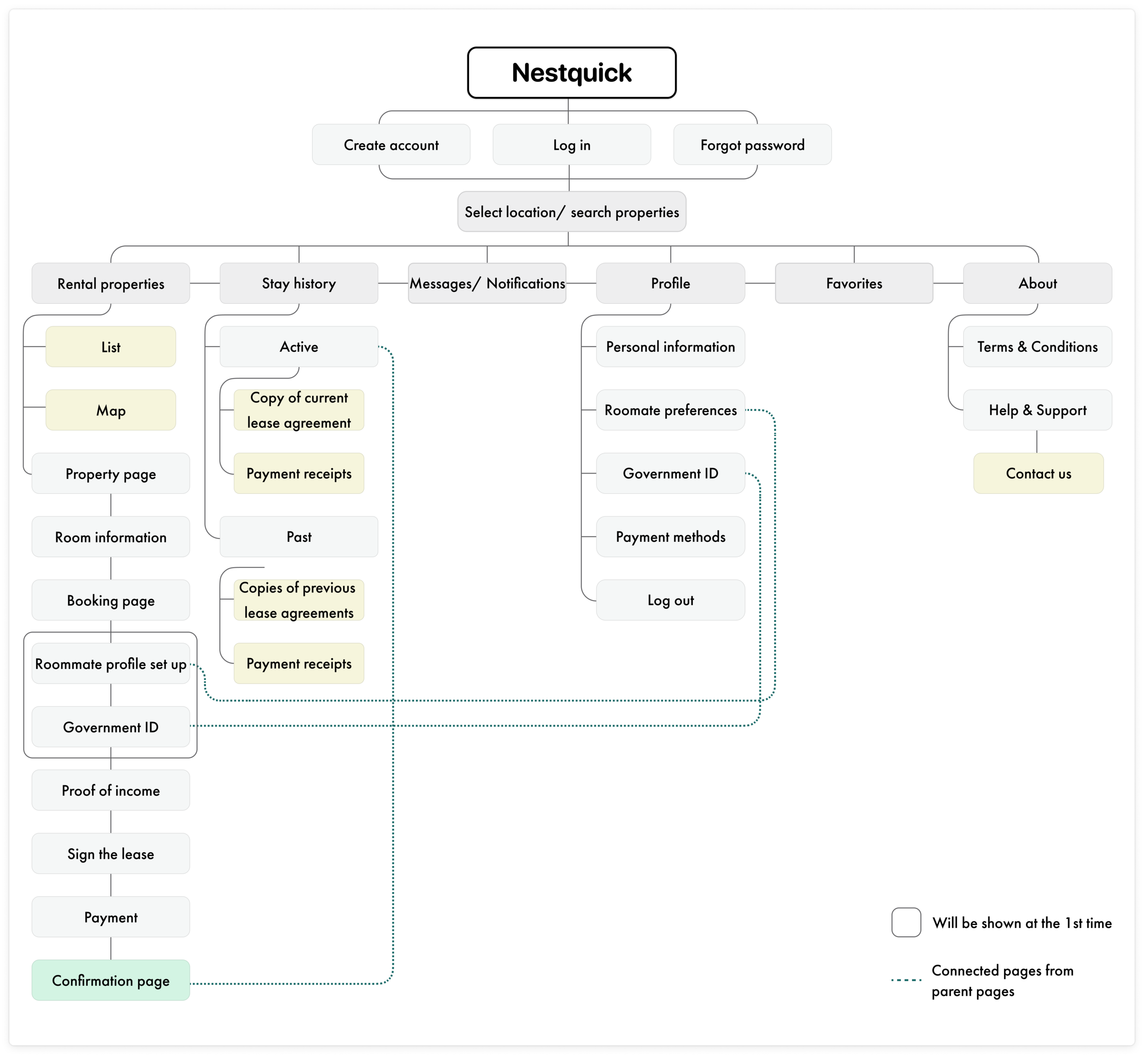
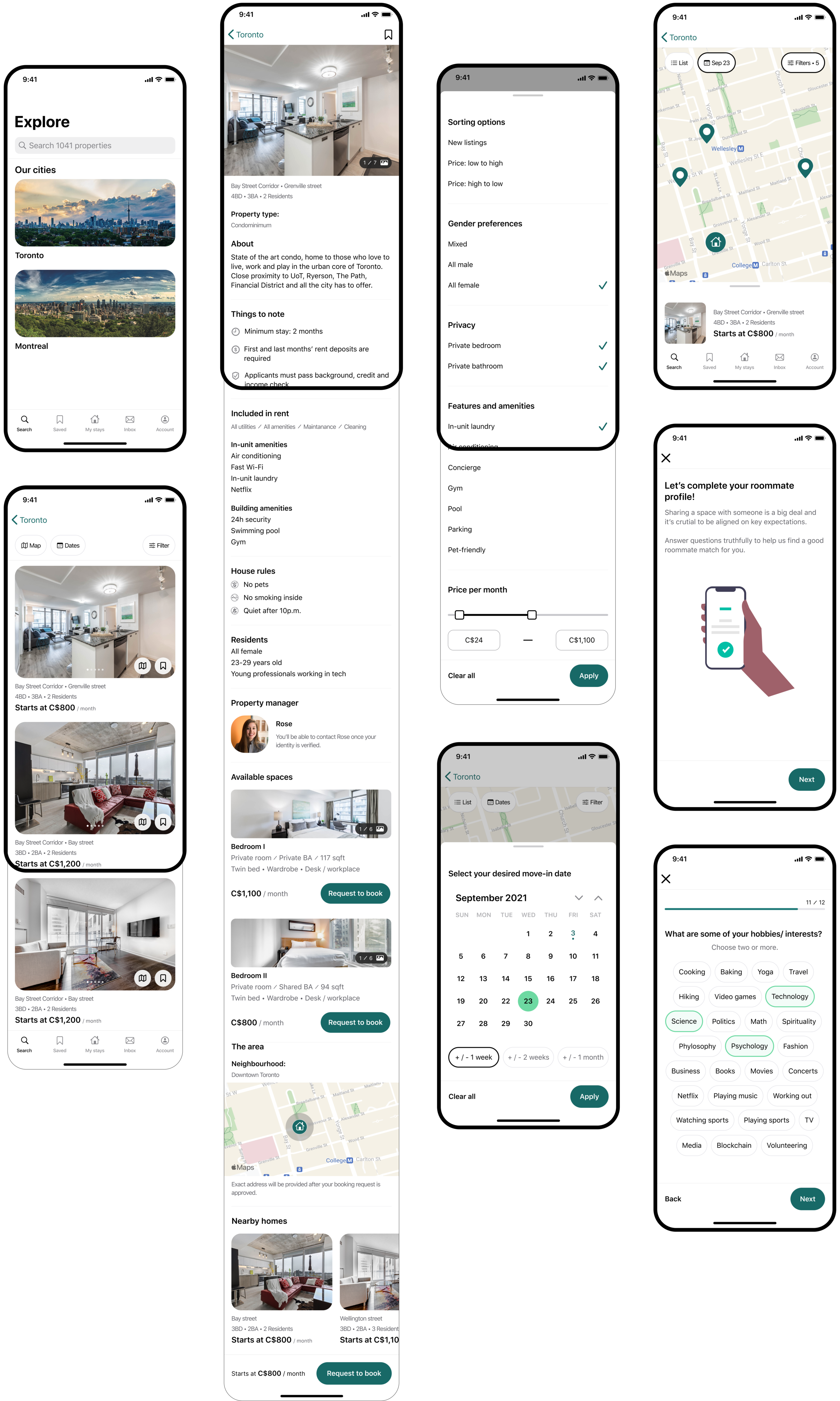
I then outlined a core task flow, where I was focusing on the social layer of the service: the user sends a request to book a room at the co-living property and fills out their roommate profile.
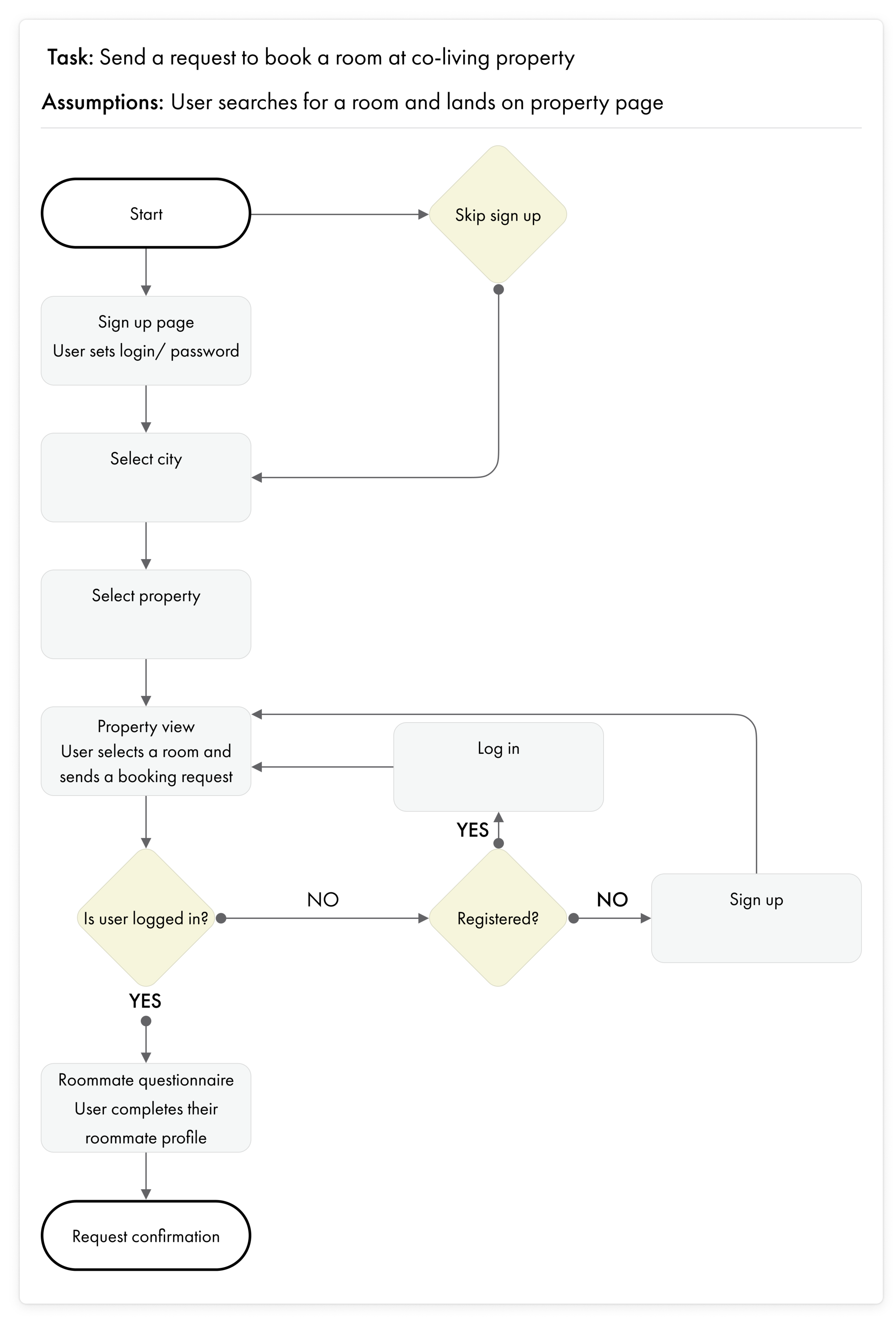
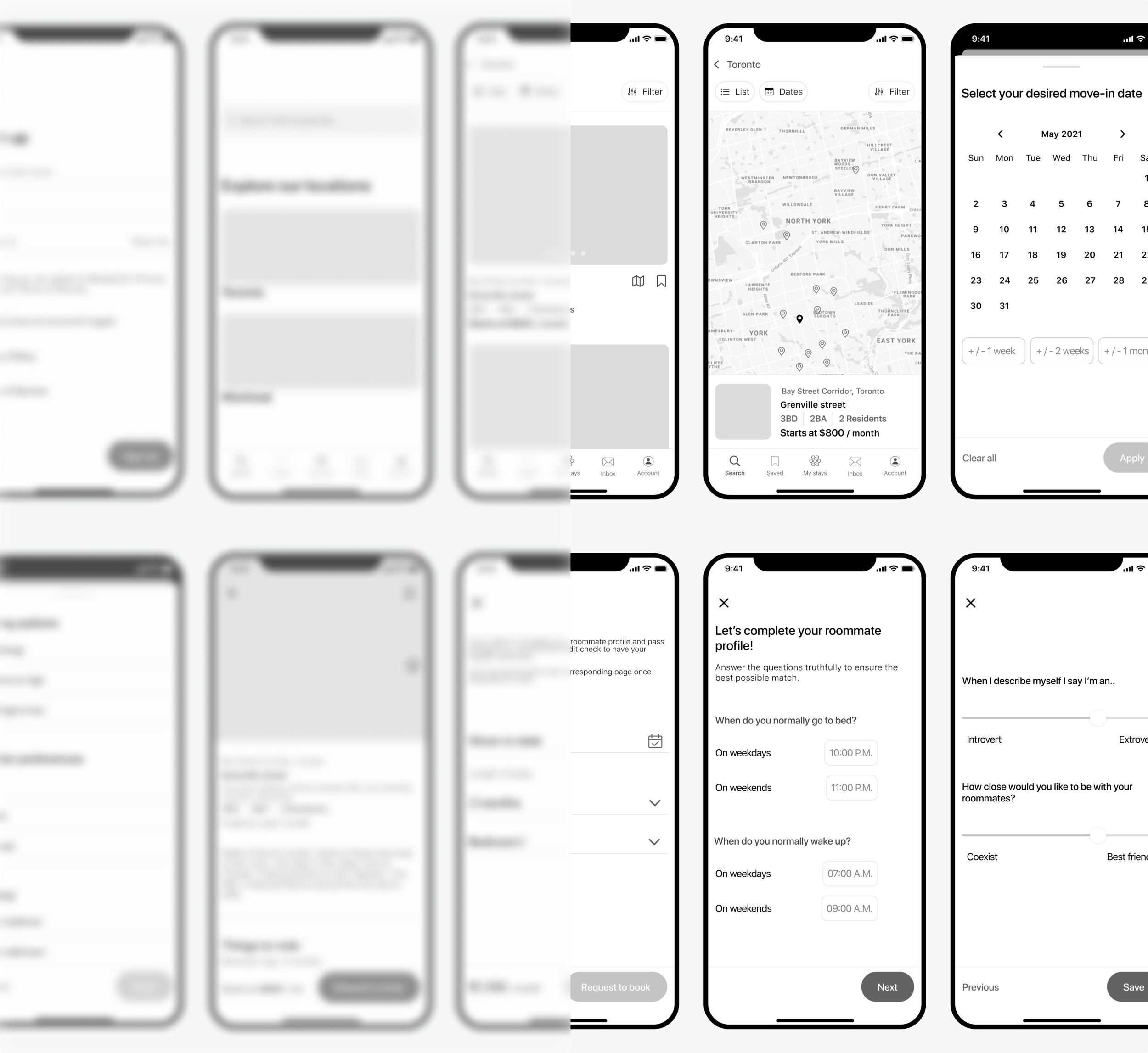
Based on the selected task flow, I moved on to drawing paper sketches of the app. I posted my sketches in the design community I’m a member of and checked with my design mentor to ensure objectivity in picking optimal options.
Those chosen sketches then evolved into the set of mid-fidelity wireframes.
VI. Usability testing
I wanted to observe and measure if users understood the app, its value and how to complete basic functions through testing the mid-fidelity prototype.
Test objectives
⇢ Observe if users are able to browse rental properties without having to create an account
⇢ Determine if property cards and pages provide users with all necessary information before deciding to create an account
⇢ Observe how users navigate and how easily they find information about rental properties
⇢ Determine if the existing features and structure helps users to achieve their goals with ease and satisfaction
Methodology
Both in-person and remote moderated usability tests were conducted. The test included a short briefing and task performance with Nestquick mobile app. I tested my prototype with 5 users (the same participants I interviewed in the research stage and whom my personas are based on).
Usability test results: findings & insights
➣ 2 out of 5 mentioned they appreciated that they could skip sign up until they have a chance to try the app and decide to commit
➣ 4 out of 5 liked the design and found it intuitive. They could start using the service with minimal learning curve
➣ 3 out of 5 said they liked the fact they could see important property details and add properties they were interested in to favorites from the search results page
As a result of usability testing, I implemented some minor changes in verbiage, added filtering options and tweaked the property card design to improve visual hierarchy. I also enlarged map pin touch points to 44pt for easier use.
I already had some high-fidelity screens ready and started establishing the design system by the time the Accessibility Course I enrolled in took the wheel. An opportunity to observe how users with different types of visual impairments interact with digital products and conduct usability tests with them, had an immense impact on the way I perceive interfaces now. I’m certain that technology is to bring delight, utility and inclusion, as opposed to leaving behind individuals or communities who seem not to fit in.
VII. Visual identity & a11y
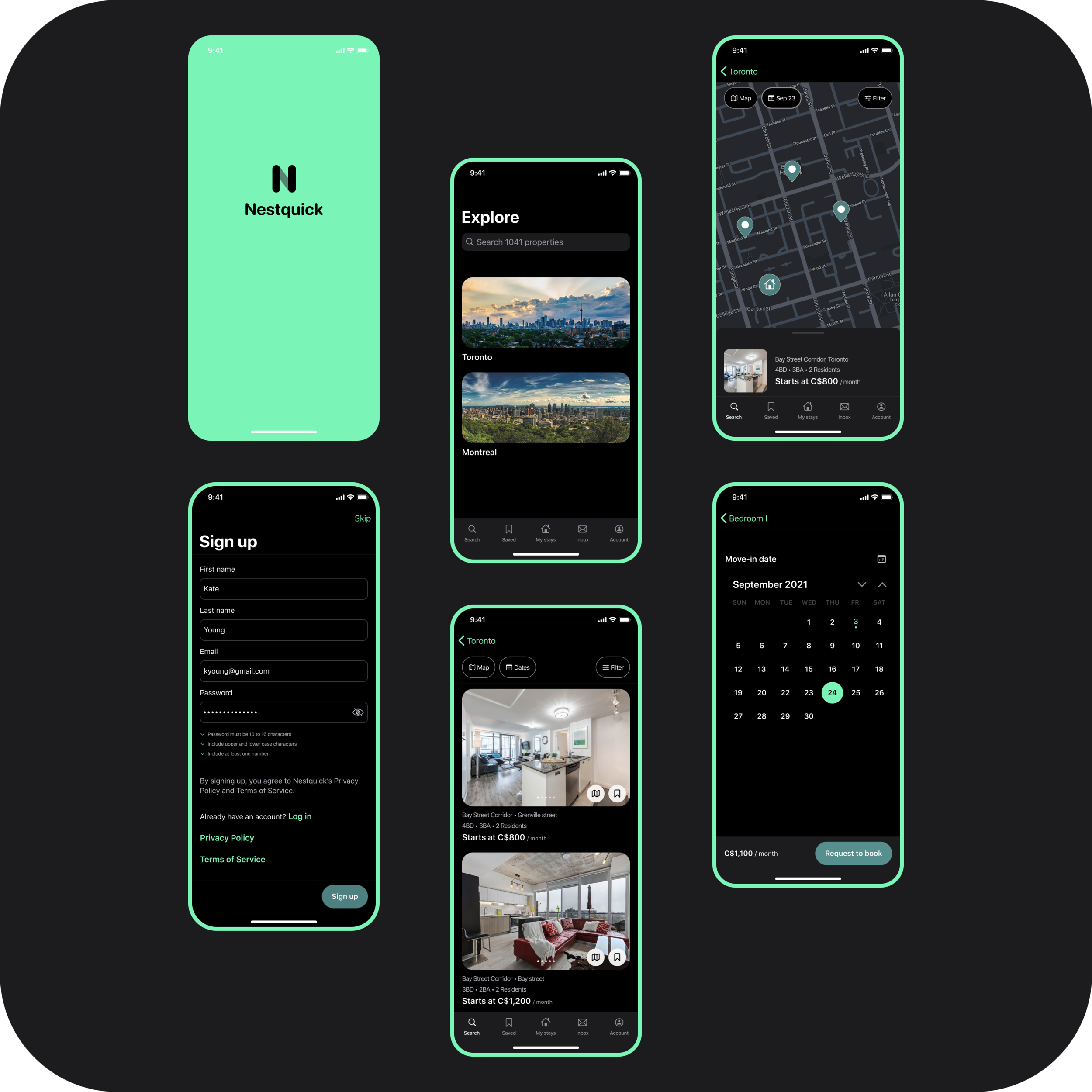
Nestquick’s voice is positive, friendly and down-to-earth.
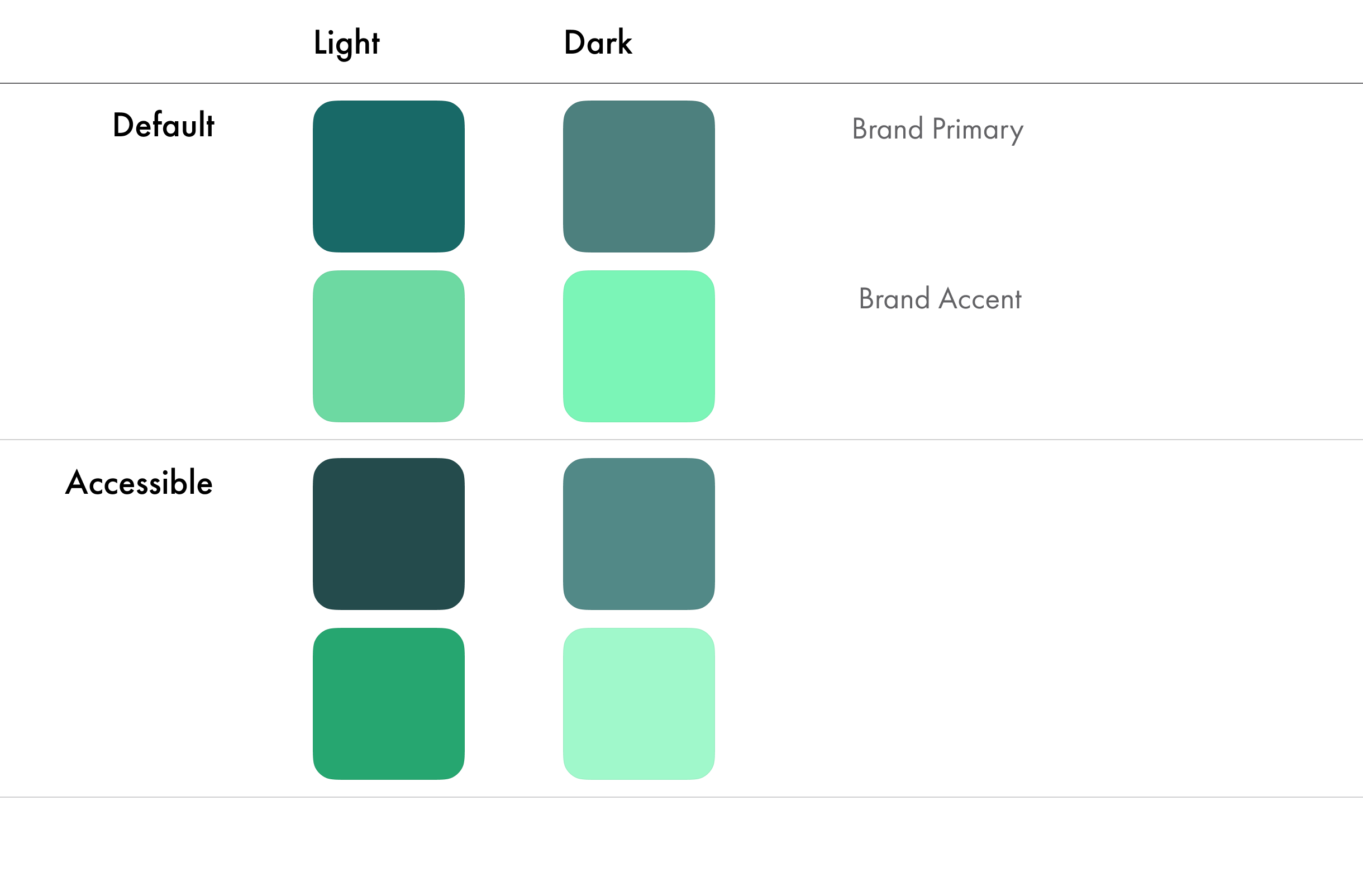
I opted for a limited color palette and chose a brand color to convey functionality and keep the UI minimalist and simple. I also defined one accent color to communicate interactivity throughout the app and add an optimistic, friendly and more casual feel to the product.
To ensure Smart Invert and Increased Contrast modes work seamlessly, iOS native UI and text colors were used in most cases. As for my brand and accent colors, I developed four versions of each to make sure the interface looks good and delivers a proper contrast ratio in all modes.
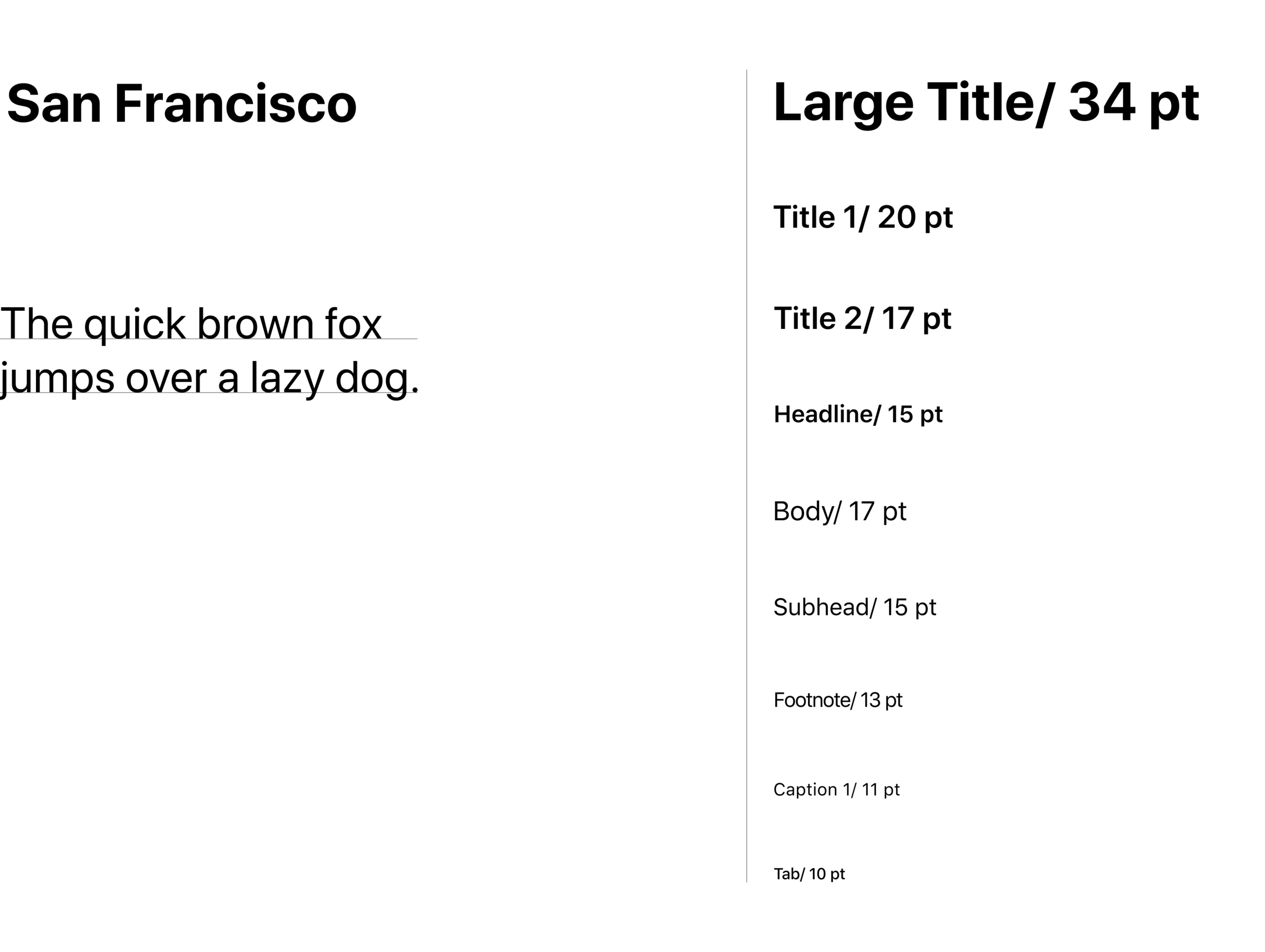
While hypothetically any type can be turned into Dynamic Type by calculating a scale factor to scale up and down and building it into a design system, I still used dynamic type sizes native to iOS to facilitate implementation and avoid any unnecessary hassle.
As mentioned before, I made some changes to my design system to meet accessibility requirements.
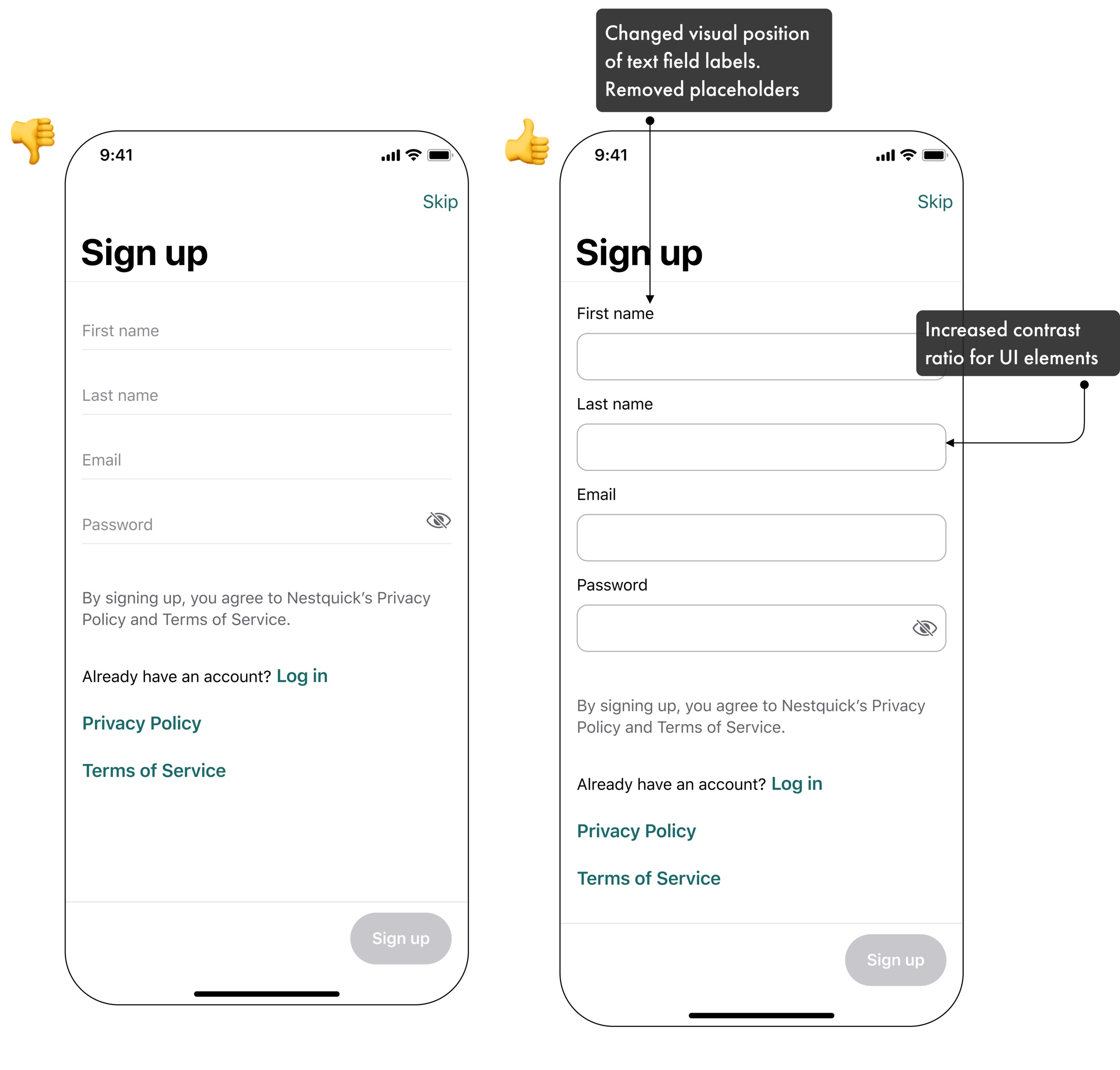
➣ 1. I started out with eliminating placeholders and floating labels. Text field labels were placed above inputs to ensure they are visible at all times.
➣ 2. Adjusted the contrast ratio of non-text UI components to at least 3:1 (form input borders).
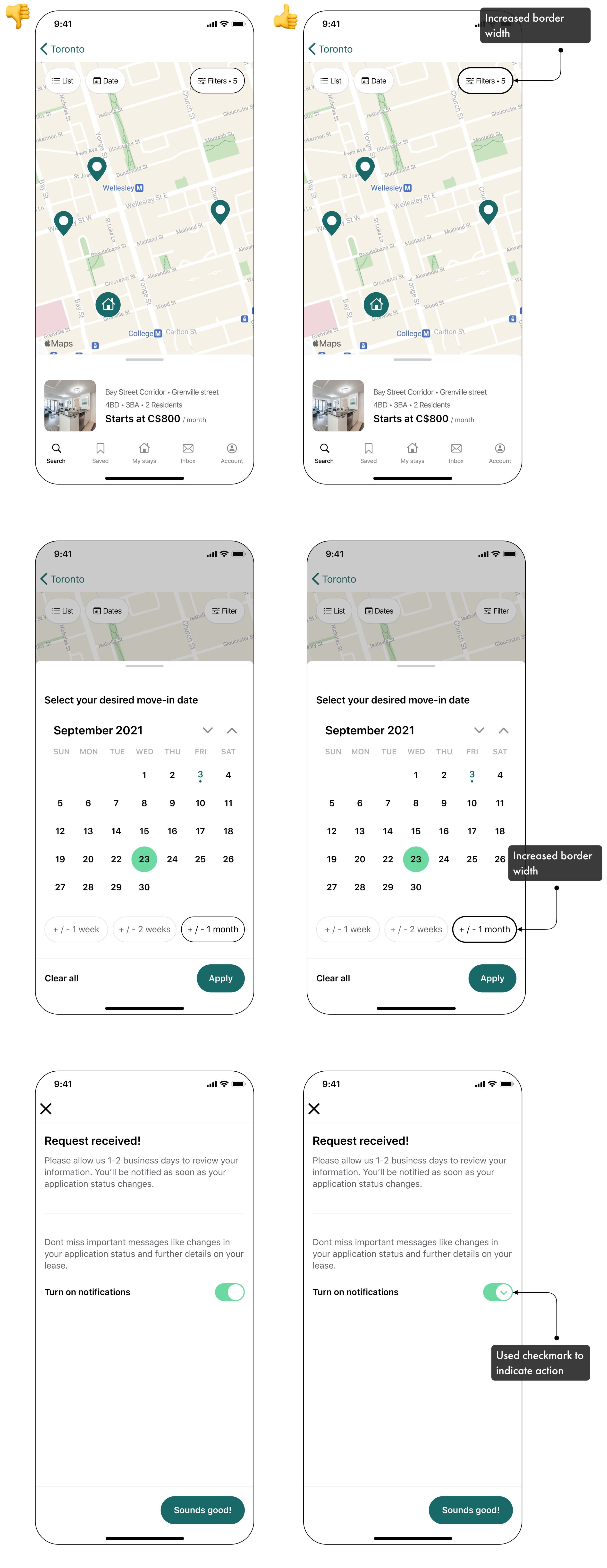
➣ 3. Stopped relying solely on color to convey information. Made sure to differentiate without color, so that users with colorblindness and other visual impairments could receive the information conveyed with color through other visual means.
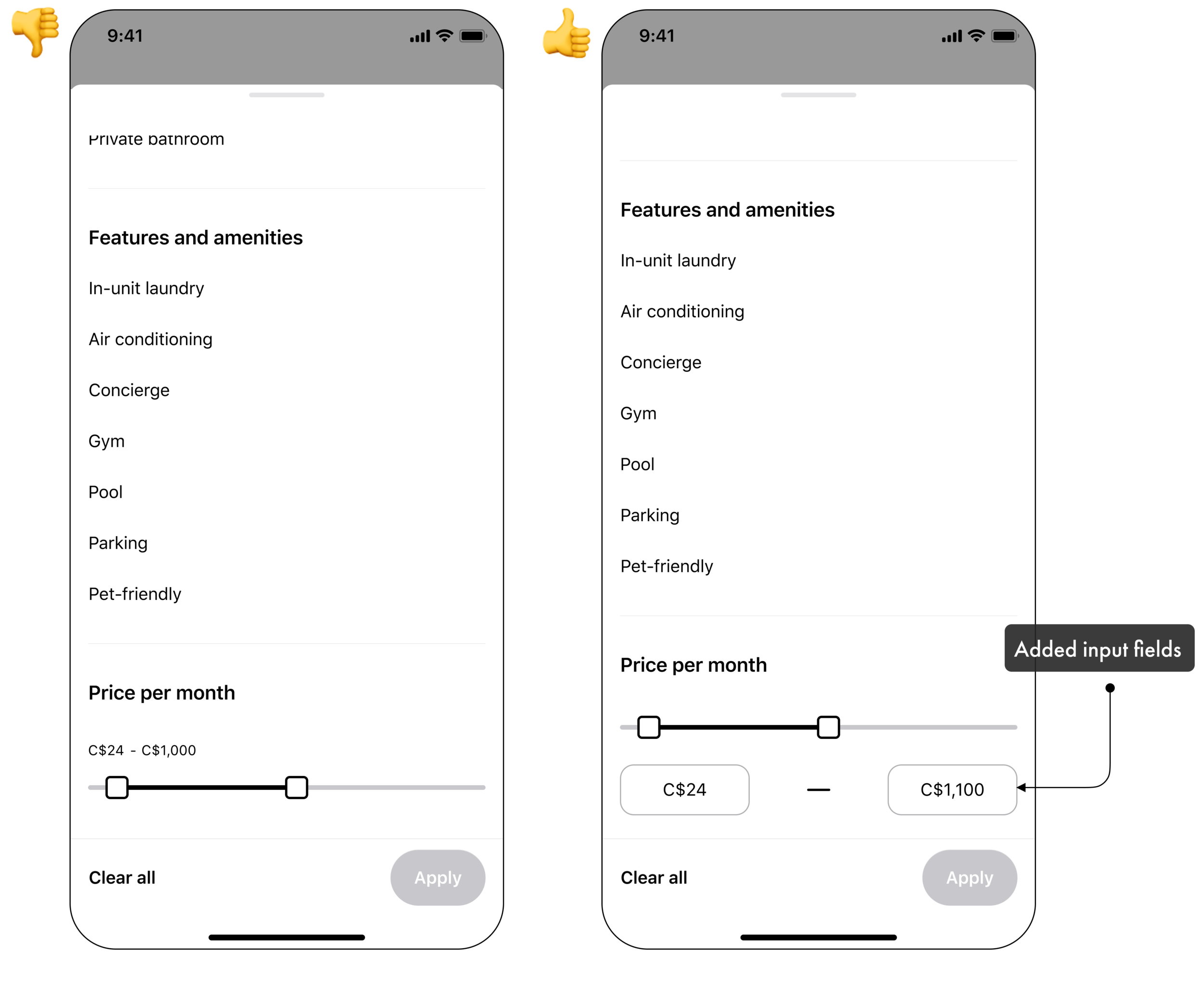
➣ 4. Added input fields to sliders to enable manual entry for VoiceOver users.
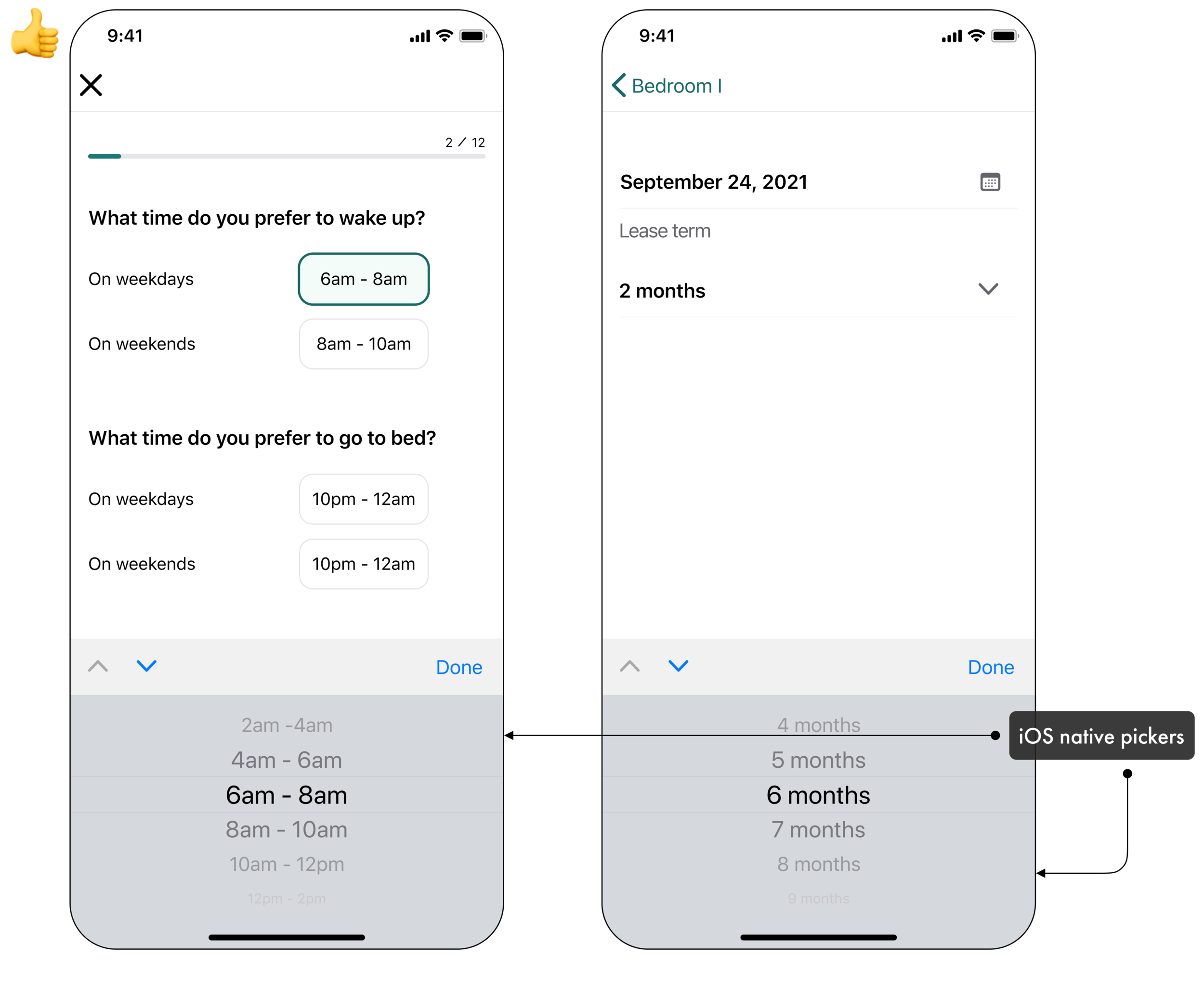
➣ 5. Took advantage of utilizing iOS native UI components as much as possible (pickers in particular). I consulted with VoiceOver users on what types of controls and pickers they find the most fulfilling. Apparently, UI components native to iOS tend to work seamlessly, while custom ones are often poorly implemented and, thus, unusable.
Conclusion
It was a long journey and I learned a lot during this project. I changed from someone who reads Human Interface Guidelines and attempts to follow them, into a person who deeply cares about digital accessibility at all levels (thanks to iOS built-in accessibility features I had to get a grasp of). As a result, I attained a more extensive understanding of human-centered product development and an ability to empathize with larger user communities.
And last but not the least, I designed an app to help improve people’s experience of living with roommates.